
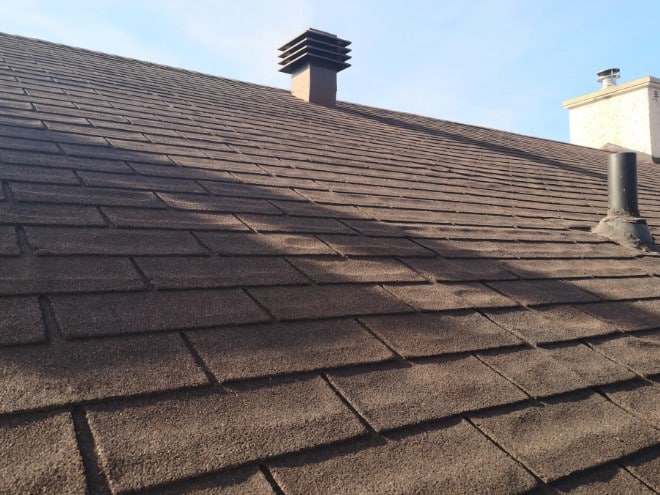

“How long should my roof last?”
It is the most common question we get at Cornerstone Roofing. If you look at the marketing brochure on a bundle of shingles, it might say “25 Years” or even “Lifetime Limited Warranty.” But in the real-world laboratory of Middle Georgia, those numbers can be misleading.
We follow the “15-Year Rule.” In our climate—with its unique mix of high heat, high humidity, and severe storms—an asphalt shingle roof typically begins to reach the end of its functional life between year 15 and year 20. If your roof was installed around 2005-2009, you are currently in the critical decision window.
Why Georgia Roofs Age Faster
Think about what your roof endures. It isn’t just a hat for your house; it is a shield that takes a daily beating.
- UV Radiation: The sun is relentless in Perry and Warner Robins. Over 15 years, UV rays slowly dry out the petrochemical oils in the asphalt. These oils are what keep the shingle flexible and waterproof. Once they are gone, the shingle becomes brittle and gray.
- Thermal Shock: This is a major factor in the South. In spring and fall, your roof might be 45°F in the morning, heat up to 140°F by 2 PM, and then be rapidly cooled to 70°F by an afternoon thunderstorm. This constant expansion and contraction stresses the materials daily. After 15 years, the fiberglass mat begins to tear under this stress, leading to vertical cracks known as “thermal splitting.”
The Danger Zone: Years 15-20
Once your roof passes its 15th birthday, it enters what we call the “Danger Zone.” You might not have a massive leak yet, but the risk of failure increases exponentially with every storm.
- Brittleness: An old shingle loses its ability to flex. A 50 mph wind gust that a new roof would shrug off can snap an old, brittle shingle in half.
- Sealant Failure: The adhesive strips that hold your shingles down can dry out and lose their grip over time. This leads to “zippering,” where a section of shingles blows off in a sheet during a storm.
- Granule Loss: As shingles age, they shed their protective granules. These granules act as sunscreen for the asphalt. Once they are gone, the sun eats right through the shingle to the decking. Check your gutter downspouts—if you see a pile of ceramic sand at the bottom, your roof is shedding its skin.
The Hidden Financial Risk: Insurance Depreciation (ACV)
There is another reason the “15-Year Rule” is so critical, and it has nothing to do with leaks—it has to do with your wallet.
Many homeowner insurance policies have a clause regarding Actual Cash Value (ACV) vs. Replacement Cost Value (RCV).
- RCV: If your roof is newer (usually under 10-15 years), the insurance company pays to replace the roof at today’s prices.
- ACV: Once your roof hits a certain age (often 15 years), many policies switch to Actual Cash Value. This means they only pay for what the old roof is worth today, not what it costs to replace.
Example: If a storm destroys your 18-year-old roof, and a new roof costs $15,000, an ACV policy might only pay you $3,000 because they depreciate the roof’s value based on its age. You would be stuck paying the $12,000 difference out of pocket.
Replacing your roof before a disaster strikes ensures you aren’t caught in this insurance depreciation trap.
Proactive vs. Reactive Replacement
As a homeowner, you have a choice. You can replace your roof on your own terms, or you can wait for a disaster to force your hand.
The Reactive Approach: Waiting until you have a leak means you are often paying for more than just a roof. You are paying for drywall repair, painting, wet insulation replacement, and possibly mold remediation. Plus, you are trying to schedule a roofer during an emergency (like after a big storm) when availability is low and prices might be higher.
The Proactive Approach: Replacing your roof at the 15-18 year mark allows you to:
- Budget: Plan for the expense rather than being blindsided.
- Choose: Take your time to select the exact shingle color and style (like Atlas Pinnacle Pristine) that boosts your curb appeal.
- Protect: Avoid the stress of internal water damage entirely.
If your home was built around 2005-2010, it is time to start thinking about your roof. Call Cornerstone Roofing and Restoration for a “Health Check” on your aging roof today. We will give you an honest assessment of how much life is left.