
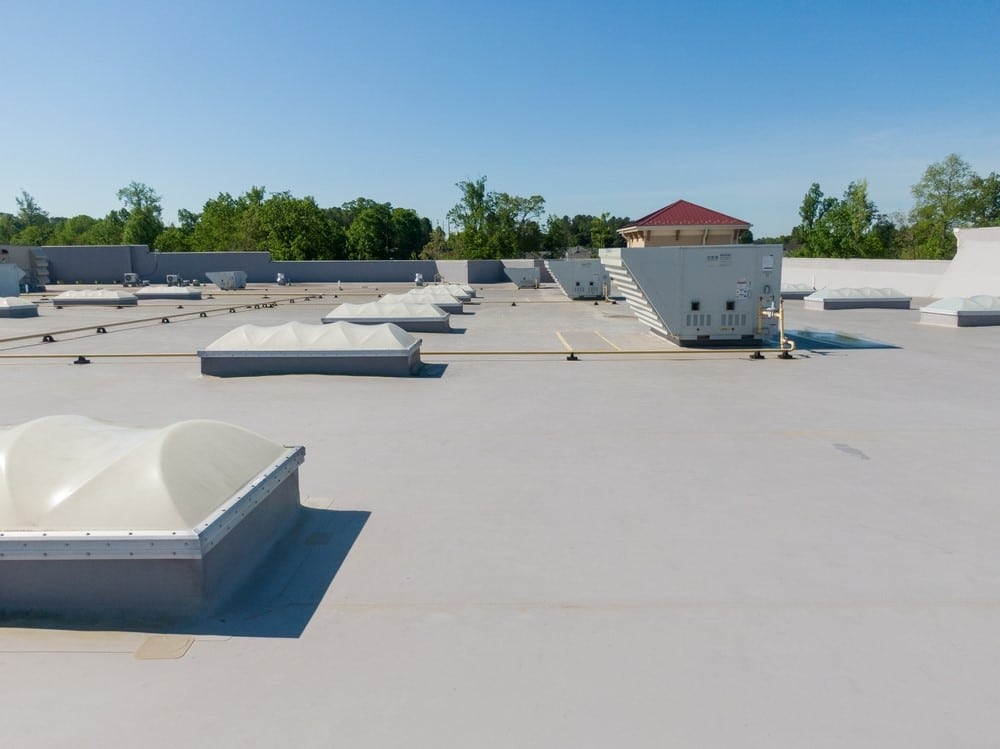

If you own a commercial building in Middle Georgia—whether it’s a warehouse in Warner Robins or a retail space in Perry—you know that our rainstorms are intense. We don’t just get sprinkles; we get torrential downpours that dump inches of water in an hour.
For flat roofs (low-slope roofs), this presents a major challenge: Drainage.
At Cornerstone Roofing and Restoration, the most common issue we see on commercial properties is “ponding water.” This is defined as water that stands on a roof for more than 48 hours after a rain event. If you have “lakes” on your roof, you have a problem that is eating away at your bottom line.
Why Standing Water is the Enemy
Ponding water is destructive for several reasons:
- Membrane Degradation: Whether you have TPO, EPDM, or Modified Bitumen, standing water acts like a magnifying glass for the sun. It intensifies UV rays, causing the membrane to break down, crack, and blister prematurely.
- Structural Stress: Water is heavy. A 1-inch deep pool of water over a 20×20 foot area weighs roughly 2,000 pounds. That is a literal ton of extra weight your steel or wood joists have to support 24/7.
- Leak Amplification: If there is a tiny pinhole in your roof, rain might just flow over it. But if that pinhole is underwater for days, the pressure will force water into your building, ruining ceiling tiles, inventory, and equipment.
The Solution: Tapered Insulation Systems
Many older commercial buildings in our area were built “dead flat.” To fix this, we don’t just add a new layer of roofing; we change the geometry of the roof.
We specialize in designing and installing Tapered Insulation Systems. Think of this as landscaping for your roof. We install rigid insulation boards that are cut at a slight angle. By laying these out in a specific pattern, we create a slope that forces water away from the center and directly toward your drains, scuppers, or gutters.
TPO: The Cool Roof Choice
For the replacement membrane, we highly recommend TPO (Thermoplastic Polyolefin).
- Energy Efficiency: TPO is typically white and highly reflective. In the scorching Georgia summer, a black tar roof can reach 170°F. A white TPO roof might only reach 110°F. This drastically reduces the load on your commercial HVAC units.
- Durability: TPO is heat-welded at the seams. This means the sheets are fused together into one monolithic piece, making them incredibly resistant to leaks.
Don’t let your business assets get soaked. If you notice standing water on your commercial roof, call Cornerstone for a drainage analysis today.