

Last updated August 2026 by the team at Cornerstone Roofing and Restoration, Perry, GA
The short answer
How much does a new roof cost in Macon and Warner Robins? Most homeowners in Bibb and Houston County pay between $9,500 and $16,000 for a complete architectural asphalt shingle replacement on a typical 2,000-square-foot home in 2026. Smaller ranch homes frequently come in between $7,000 and $10,000. Larger or steeper homes, or those needing significant decking repair, can reach $18,000 to $25,000. Standing seam metal roofing generally runs two to three times the cost of shingles.
How do you know when to replace your roof? Replace it when the roof is past roughly 18 to 22 years old for a three-tab shingle system or 22 to 28 years for architectural shingles, or when you see any of the following regardless of age: granules collecting in your gutters, shingles curling or cupping at the edges, bare or cracked shingles, daylight visible through the attic decking, active or recurring leaks, sagging rooflines, or repeated repairs to the same area. In Middle Georgia the more common trigger is not old age at all — it is storm damage, and the sign is usually granule loss and bruised shingles rather than anything dramatic.
The rest of this guide breaks both answers down in detail, with the specific factors that move pricing in Macon and Warner Robins, how insurance handles roof claims in Georgia, and a practical checklist you can walk through yourself before calling anyone.
Part One: What a New Roof Actually Costs in Middle Georgia
How roofers price a job: the “square”
Every roofing quote you receive is built on a unit called a square, which equals 100 square feet of roof surface. A typical Middle Georgia single-family home has somewhere between 18 and 35 squares.
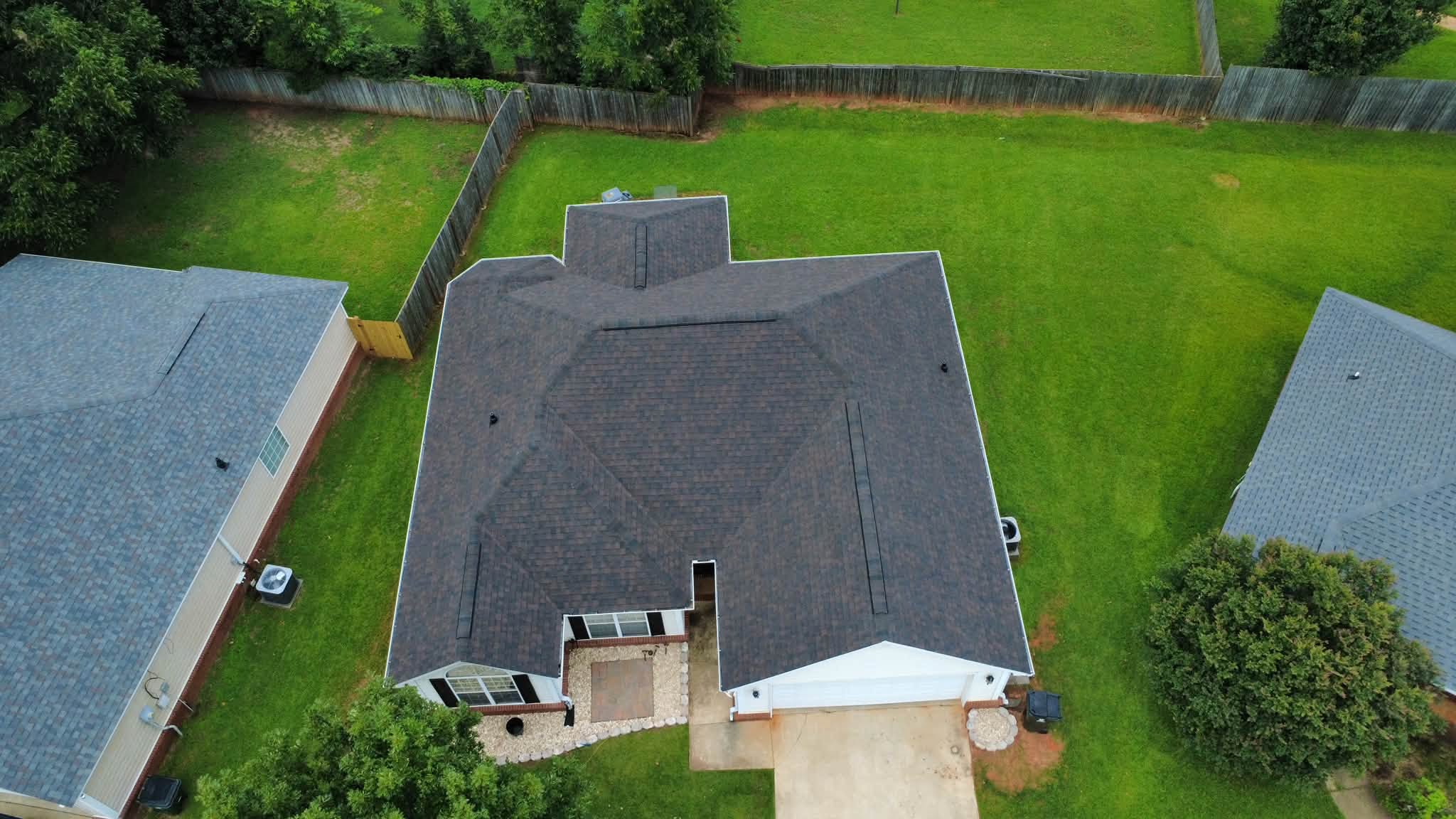
An important detail that surprises most homeowners: your roof is larger than your house. A 2,000-square-foot home does not have a 2,000-square-foot roof. Because the roof slopes, the actual surface area is greater than the ground-level footprint. On a common 6/12 pitch, you multiply the footprint by roughly 1.118, then add for overhangs. That 2,000-square-foot home ends up with closer to 2,300 square feet of roof, or about 23 squares.
This is exactly why online calculators and “cost per square foot of house” estimates run low, and why an in-person or satellite measurement is the only way to get a number you can budget against. When Cornerstone provides a free roof inspection and estimate, we measure the actual roof planes, not the house footprint.
2026 pricing by home size — Macon and Warner Robins
| Home size | Approx. roof area | Architectural shingles | Standing seam metal |
|---|---|---|---|
| 1,000–1,400 sq ft (small ranch, older in-town home) | 12–17 squares | $5,500 – $9,500 | $14,000 – $22,000 |
| 1,500–2,000 sq ft (most common in Houston County) | 18–24 squares | $9,500 – $16,000 | $22,000 – $34,000 |
| 2,500–3,000 sq ft (two-story, newer subdivision) | 28–36 squares | $15,000 – $24,000 | $32,000 – $50,000 |
| 3,500+ sq ft (custom, complex rooflines) | 40+ squares | $22,000 – $35,000+ | $45,000+ |
Statewide, published 2026 figures for Georgia roof replacement generally land between $8,000 and $18,000 for a standard single-family home, with architectural asphalt shingles installing at roughly $350 to $550 per square. Middle Georgia typically sits at or slightly below the state midpoint, because labor rates in Bibb and Houston County run below metro Atlanta rates. That is a real advantage for local homeowners — the same roof that costs $16,000 in Alpharetta often lands closer to $12,500 in Warner Robins.
Pricing by material
Three-tab asphalt shingles — $3.50 to $5.00 per square foot installed
The entry-level option, and increasingly rare on new installs. Flat, uniform appearance, typically 20 to 25 year rated life, and lower wind ratings. Reasonable if you are selling within a couple of years or working with a hard budget ceiling, but the price gap versus architectural shingles has narrowed enough that most Middle Georgia homeowners step up.
Architectural (dimensional) shingles — $4.50 to $7.00 per square foot installed
This covers roughly nine out of ten residential replacements in our service area. Thicker, layered construction gives a dimensional shadow line, better wind performance, and a 25 to 30 year practical lifespan. Cornerstone installs the full Atlas Roofing product line, and you can review manufacturer specifications directly at Atlas Roofing and compare against the systems documented by Owens Corning.
Impact-resistant (Class 4) shingles — add 10% to 20%
Worth serious consideration in Middle Georgia. Class 4 shingles are tested to resist hail impact, and many Georgia carriers offer a premium discount for them. Over a 25-year roof life, that discount frequently offsets a meaningful share of the upcharge. Ask your agent what your specific carrier allows before deciding.
Standing seam metal — $7.00 to $14.00 per square foot installed
Two to three times the upfront cost of shingles, with roughly double the service life and excellent performance in wind and heat. Increasingly popular on rural properties around Byron, Kathleen, and the areas outside Macon proper. Reflective metal and cool-roof shingle products can also reduce summer cooling load; the ENERGY STAR program maintains guidance on qualifying roof products.
What should be included in a legitimate quote
A quote that does not itemize the following is not a complete quote, and comparing it against one that does will mislead you:
- Tear-off and disposal of the existing roof, including dumpster and landfill fees
- Decking inspection and a stated per-sheet price for replacing rotted plywood
- Underlayment — synthetic underlayment across the field, ice-and-water shield in valleys and around penetrations
- Starter strip and ridge cap shingles, which are separate products from field shingles
- Drip edge at eaves and rakes
- New flashing at chimneys, walls, and skylights — reusing old flashing is a common corner-cut
- Pipe boots and vents, replaced rather than reset
- Ridge and soffit ventilation assessment
- Cleanup and magnetic nail sweep
- Both warranties — the manufacturer’s material warranty and the contractor’s separate workmanship warranty
The seven factors that move your price
- Roof size. The single largest driver. More squares means more material, more labor hours, more disposal.
- Pitch. Anything steeper than roughly 7/12 requires additional safety equipment and slows the crew. Expect a 10% to 25% increase.
- Complexity. Valleys, dormers, hips, skylights, chimneys, and multiple roof planes all add labor and flashing. A simple gable roof and a cut-up roof of identical square footage are not the same job.
- Number of existing layers. Two layers of old shingles means double the tear-off labor and double the disposal weight.
- Decking condition. This is the wild card, and it is the reason honest contractors quote a per-sheet rate rather than pretending it will not happen. Georgia’s humidity produces rotted decking routinely, and you genuinely cannot know what is under there until the old roof comes off. Budget for a few sheets.
- Material selection. Covered above — the range from three-tab to standing seam metal is roughly 4x.
- Access. Two-story homes, tight lot lines, limited driveway space for the dumpster, and landscaping that must be protected all add time.
What is specific about Macon and Warner Robins
These are two genuinely different roofing markets, and the pricing conversation differs accordingly.
Macon has a deep stock of older homes, including significant historic housing in and around the in-town neighborhoods. Older homes bring older framing, more plank decking rather than plywood, more complex Victorian and Craftsman rooflines, and more frequent discovery of prior repair work done poorly. They also bring mature tree cover — Macon’s canopy is one of its best features and one of the hardest things about its roofs. Shade holds moisture, moisture grows moss and algae on north-facing slopes, and limbs abrade shingles in every storm. Macon quotes more often include decking allowances and gutter work.
Warner Robins is dominated by newer construction, much of it built in identifiable waves tied to growth around Robins Air Force Base. This produces a distinctive pattern: entire subdivisions reach roof-replacement age at roughly the same time. If your neighbors are getting roofs, that is not a coincidence and it is not necessarily storm chasers — it is the original builder-grade shingles hitting end of life on the same schedule. Warner Robins roofs tend to be simpler in geometry, which usually means cleaner pricing and faster installs.
Both cities sit in the same weather pattern: intense summer heat and UV, high humidity year round, spring and summer thunderstorm activity, and periodic damaging hail and straight-line wind. Heat and UV are the quiet killers here. A roof in Middle Georgia does not typically fail because of a single dramatic event; it fails because a decade of 95-degree summers has baked the asphalt binder out of the shingles, and then one ordinary storm finishes the job.
We also serve the surrounding communities where these same patterns show up — Bonaire, Kathleen, Byron, Forsyth, and Gray. You can see our full coverage on our service areas page.
How insurance changes the number
A large share of roof replacements in Middle Georgia are paid substantially by insurance rather than out of pocket, and understanding the mechanics before you file matters a great deal.
Replacement Cost Value (RCV) policies pay what it costs to replace the roof today, usually in two payments: an initial check less depreciation and your deductible, then the recoverable depreciation once work is complete and documented.
Actual Cash Value (ACV) policies pay the depreciated value only. On a 17-year-old roof, that can be a fraction of replacement cost. Many Georgia carriers have shifted older roofs onto ACV schedules or added separate wind/hail deductibles expressed as a percentage of dwelling coverage rather than a flat dollar amount. Check your declarations page before you need it. The difference between RCV and ACV on the same roof can be more than $10,000.
If you run into difficulty with a carrier, the Georgia Office of Insurance and Safety Fire Commissioner regulates insurers in this state and its consumer resources and complaint process are available to any policyholder. Cornerstone works claims regularly and will meet your adjuster on the roof, but we are contractors, not public adjusters, and we will always tell you plainly which is which.
Financing
A roof is rarely a planned purchase. Cornerstone partners with Hearth to offer financing options with prequalification that does not affect your credit score. For most homeowners the practical comparison is monthly payment versus the cost of continued repairs and interior damage, not the sticker price in isolation.
Part Two: How Do I Know When to Replace My Roof?
Start with age
Age is the baseline, not the verdict — but it tells you when to start paying attention.
| Roof type | Rated life | Realistic life in Middle Georgia |
|---|---|---|
| Three-tab asphalt shingles | 20–25 years | 15–20 years |
| Architectural asphalt shingles | 30–50 years | 22–28 years |
| Impact-resistant (Class 4) shingles | 30–50 years | 25–30 years |
| Standing seam metal | 50+ years | 40–50 years |
| Screw-down metal panel | 30–40 years | 25–35 years (fastener gaskets fail first) |
Note the gap between the rated life and the realistic life. Manufacturer ratings are established under controlled conditions. Our combination of UV exposure, sustained heat, and humidity consistently pulls real-world performance below the number on the wrapper. A “30-year shingle” installed in Warner Robins in 2001 is very likely at the end of its service life right now.
If you do not know your roof’s age: check your closing documents, ask a neighbor in a same-era subdivision, or look for a permit record with the local building department. Bibb and Houston County both maintain permit records.
The twelve signs it is time — a checklist you can run yourself
From the ground, with binoculars — do not climb on your roof:
- Curling or cupping shingle edges. Edges lifting upward or corners turning under. This is heat and age driving moisture out of the mat. Once it is widespread, the roof is done.
- Bald spots or visible dark patches. Granules are the shingle’s sunscreen. Where they are gone, the asphalt underneath is being cooked directly by UV.
- Cracked or split shingles. Straight-line splits across the field usually mean thermal cycling has exhausted the shingle’s flexibility.
- Missing shingles or tabs. One or two after a storm is a repair. A scattered pattern across multiple slopes means the sealant strips have released and the whole field is vulnerable.
- A sagging or wavy roofline. Sight down the ridge from the street. A ridge should be dead straight. Any dip, bow, or wave indicates a structural or decking problem, and that is urgent rather than routine.
- Moss or heavy algae streaking. Common on shaded north-facing slopes in Macon. Black streaking is largely cosmetic; thick moss holds moisture against the shingle and shortens its life materially.
- Rusted, cracked, or lifting flashing around chimneys, vents, and wall intersections. Flashing failures cause a large share of the leaks we repair.
- Granules in your gutters. The single most useful early indicator. Some granule loss is normal on a new roof. Persistent accumulation that looks like coarse black sand on an older roof means active deterioration. If you are also seeing gutter problems, our gutter installation and protection service is often done alongside a replacement.
From inside the attic, with a flashlight, on a bright day:
- Daylight through the decking. Pinpoints of light between rafters mean gaps water is also finding.
- Water staining on rafters or decking. Dark rings or streaks, even dry ones, are the record of past leaks. Trace them upslope to find the entry point.
- Damp insulation or a musty smell. Often the first sign of a slow leak that has not yet reached the ceiling below.
- Spongy or soft decking underfoot. If a decking sheet flexes, it has absorbed water and lost integrity.
Also watch for a rising cooling bill with no other explanation. Failed ventilation and a heat-soaked attic will show up on your Georgia Power bill before it shows up on your ceiling.
Repair or replace? A practical framework
Repair makes sense when the roof is under about 15 years old, the damage is confined to one slope or one area, the rest of the field still has good granule coverage and flexible shingles, and you can still source matching shingles.
Replacement makes sense when the roof is past roughly 18 years, damage appears on multiple slopes, you have repaired the same area more than twice, the decking is compromised anywhere, or a repair would cost more than about 30% of a full replacement.
There is also a matching problem worth knowing about. Shingle lines are discontinued and colors weather. On a roof more than about ten years old, a repair patch will not match, and on a roof more than fifteen years old you often cannot get the product at all. Insurance policies vary widely in whether they cover the cost of achieving a uniform appearance — another line to check on your declarations page.
When we perform a roof repair, we will tell you honestly if we think you are throwing money at a roof that needs replacing. We would rather lose a repair ticket than sell you two.
After a storm: what to do and when
Middle Georgia storm damage is frequently invisible from the ground. Hail bruising — where an impact fractures the mat without removing the shingle — often shows up as nothing more than a slightly darker circle with the granules knocked loose. It will not leak this year. It will leak in three years, long after the claim window closed.
- Document immediately. Photograph the storm date, any debris, and any visible damage from the ground.
- Get a professional inspection within days, not months. Georgia policies contain notice requirements, and carriers increasingly deny claims filed long after the event on the grounds that damage cannot be tied to a covered date.
- Be careful with door-knockers. After every significant Middle Georgia storm, out-of-state crews arrive. Some are legitimate. Many collect deposits and leave. Verify any contractor’s registration through the Georgia Secretary of State, confirm a physical local address, and check their record with the Better Business Bureau.
- Never sign anything that assigns your insurance benefits to a contractor without reading it fully and understanding what you are giving up.
Cornerstone has a physical office at 1307 Ball Street in Perry. We will be here next year, and the year after that, which is the entire point of hiring locally. For broader industry guidance on contractor selection and roofing standards, the National Roofing Contractors Association publishes homeowner resources, and the Insurance Institute for Business & Home Safety maintains research on roof performance in severe weather.
What a real inspection covers
A free inspection should take 45 minutes to an hour and produce a written report with photographs. Ours documents the condition of the field shingles and granule retention, all flashing and penetrations, valleys, ridge and soffit ventilation adequacy, decking condition where observable, gutters and drainage, attic moisture and staining, and a specific remaining-life estimate rather than a vague recommendation.
If an inspector spends ten minutes on your roof and immediately produces a contract, you have met a salesperson, not an inspector.
Frequently Asked Questions
How much does a new roof cost in Macon, GA?
Most Macon homeowners pay between $9,500 and $16,000 for an architectural asphalt shingle replacement on a typical home in 2026. Macon’s older housing stock and more complex historic rooflines mean decking repair and detailed flashing work are more common here than in newer subdivisions, so budget toward the upper half of that range for pre-1970 homes.
How much does a new roof cost in Warner Robins, GA?
Warner Robins homeowners typically pay $9,500 to $15,000 for architectural shingles on a standard single-family home in 2026. Simpler subdivision rooflines and newer plywood decking often keep Warner Robins projects at the lower end of the Middle Georgia range.
How long does a roof last in Georgia?
Architectural asphalt shingles realistically last 22 to 28 years in Middle Georgia, and three-tab shingles 15 to 20 years. Georgia’s heat, UV exposure, and humidity consistently produce shorter service life than the manufacturer’s rated figure.
How long does a roof replacement take?
Most single-family homes in Macon and Warner Robins are completed in one to two days. Larger homes, steep pitches, complex rooflines, or significant decking repair can extend that to three or four days. Weather is the main variable.
Will insurance pay for my new roof in Georgia?
Insurance covers roof replacement when damage results from a covered event such as wind, hail, or a fallen tree. It does not cover normal wear or age-related deterioration. Whether you receive full replacement cost or a depreciated amount depends on whether your policy is written on an RCV or ACV basis, which is stated on your declarations page.
Can I put a new roof over the old one?
It is sometimes permitted, but we generally advise against it. Overlaying hides decking damage you will not discover until it becomes expensive, adds significant weight, traps heat that shortens the new shingles’ life, and reduces or voids many manufacturer warranties. It also makes the eventual tear-off cost more.
What is the best time of year to replace a roof in Middle Georgia?
Fall and early spring are ideal — moderate temperatures let shingle sealant strips bond properly without the crew working in extreme heat. Summer installations are entirely routine here and done well year-round, but scheduling is tighter after storm season begins.
Do I need a permit to replace my roof in Macon or Warner Robins?
No. Roof replacement does not require a permit in both Bibb and Houston County.
What is the most common cause of roof failure in Middle Georgia?
Heat and UV degradation, followed by storm damage. Most roofs here do not fail suddenly; they lose granules and flexibility over a decade of hot summers, and then an ordinary thunderstorm exposes the weakness.
How do I know if a roofing contractor is legitimate?
Confirm a physical local address, verify business registration with the Georgia Secretary of State, ask for proof of general liability and workers’ compensation coverage, require a written workmanship warranty separate from the manufacturer’s material warranty, and check reviews and BBB standing. Be especially cautious with crews that appear immediately after a storm and pressure you to sign same-day.
Get a straight answer about your roof
If you are somewhere between “I think it might be time” and “I have no idea what this should cost,” a free inspection settles it. We will tell you how much life your roof has left, what a replacement would actually cost on your specific home, and whether a repair makes more sense right now. No pressure, no obligation, and a written report you can keep whether you hire us or not.
Cornerstone Roofing and Restoration
1307 Ball Street STE 1, Perry, GA 31069
(478) 508-8628
Schedule your free roof inspection →
Serving Macon, Warner Robins, Perry, Bonaire, Kathleen, Byron, and communities throughout Middle and South Georgia. Learn more about our residential roofing services.